RESTful vs RESTless Web Services: Which One Is Right For Your Project?
Understanding Web Services: The Foundation
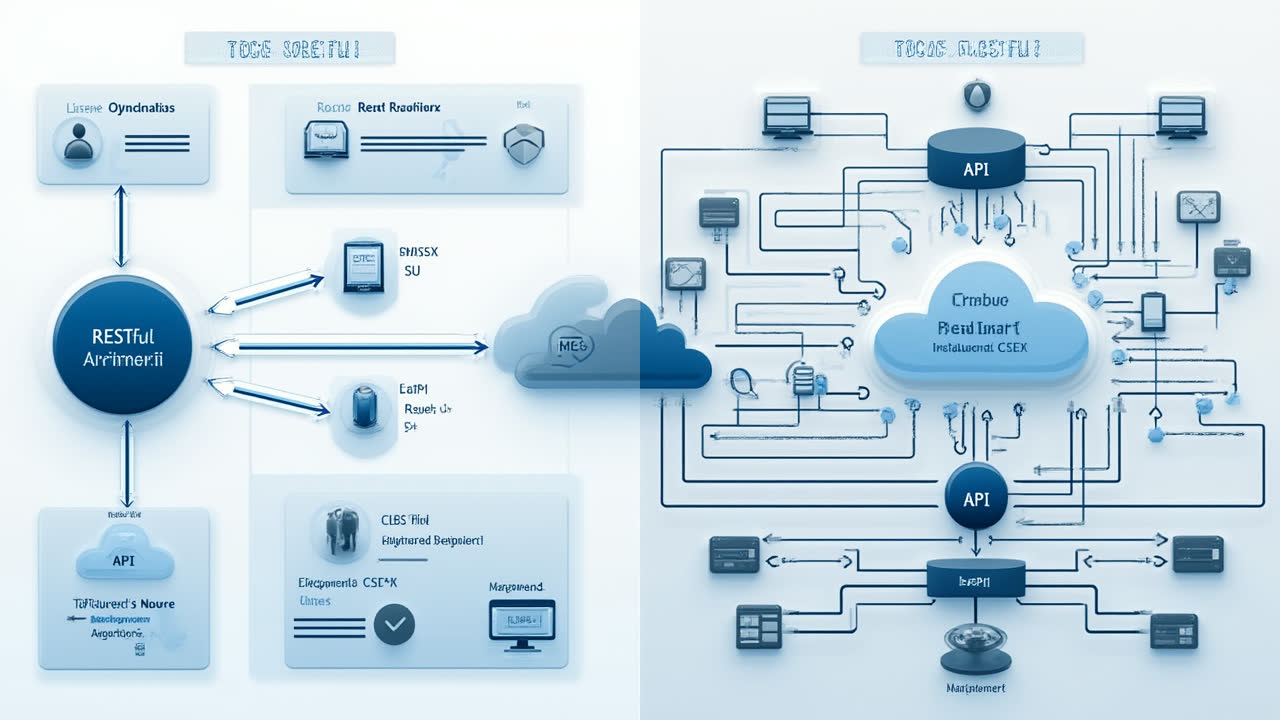
Before diving into the RESTful vs RESTless debate, let's clarify what web services actually are. Web services function as client-server applications that communicate over the World Wide Web using the Hypertext Transfer Protocol (HTTP). They provide standardized methods for exchanging data between different applications running on various platforms and frameworks - essentially serving as the digital glue that connects disparate systems.
When a user sends an HTTP request to a specific URL with appropriate arguments, the web service processes this request and returns the result as a response. The beauty of web services lies in their platform independence - they can connect applications built with completely different technologies, operating systems, or programming languages. This universal compatibility has made web services indispensable in our modern, heterogeneous computing environment.
I've worked with numerous web service implementations over the years, and I've found that understanding the architectural differences between RESTful and RESTless approaches is crucial for creating efficient, maintainable systems. Each has its own philosophy, strengths, and ideal use cases - there's no one-size-fits-all solution here. Sometimes the seemingly "simpler" option might actually create more headaches down the road!
What Are RESTful Web Services?
REST, which stands for Representational State Transfer, represents an architectural style rather than a specific protocol. Created by Roy Fielding in his doctoral dissertation, REST establishes a set of constraints designed to optimize client-server interactions on the web. Applications that adhere to these REST principles are called RESTful web services.
RESTful web services utilize URLs (Uniform Resource Locators) to identify and locate resources. One of their defining characteristics is their reliance on standard HTTP methods to perform different operations. These include:
- GET - Retrieves a specific resource or collection of resources
- POST - Creates a new resource
- PUT - Updates an existing resource
- DELETE - Removes a resource
- PATCH - Partially updates a resource
For example, a RESTful web service with the URL http://example.com/employees/10 might return information about the employee with ID 10 when receiving a GET request. The same endpoint could be used to update that employee's information by sending updated values in a PUT request. This elegant simplicity is part of what makes REST so popular.
Have you ever noticed how intuitive it feels to work with a well-designed REST API? That's not by accident. RESTful services are designed to be predictable and follow natural web patterns that developers already understand from their experience with the web itself. I remember the first time I moved from a complex SOAP implementation to REST - it felt like someone had removed a heavy backpack I'd been carrying!
Understanding RESTless Web Services
RESTless web services, as the name implies, do not adhere to REST architectural principles. The most common type of RESTless web service is SOAP (Simple Object Access Protocol). Unlike the relatively flexible nature of REST, SOAP follows a more rigid, protocol-specific approach to web service implementation.
SOAP web services function by sending XML requests over the internet using HTTP protocol and receiving XML responses in return. While this might sound similar to REST on the surface, the implementation details and philosophy differ significantly. Every application that sends SOAP requests requires a WSDL (Web Services Description Language) file, which serves as a detailed contract between the service and client.
The WSDL file describes all available methods in the web service, along with their request and response types. This strict contract provides clarity but reduces flexibility. SOAP essentially functions through remote procedure calls to objects, contrasting with REST's resource-centered approach.
I've encountered situations where the rigidity of SOAP actually saved us from potential integration nightmares, particularly when working with financial systems where the contract between systems needed to be explicitly defined and enforced. Sometimes constraints can be liberating! That said, the verbose XML structure does make debugging more challenging compared to REST's typically lighter JSON format.
Key Differences Between RESTful and RESTless Web Services
Now that we've explored both approaches individually, let's directly compare RESTful and RESTless web services across several crucial dimensions. Understanding these differences will help you evaluate which approach aligns better with your specific project requirements.
| Feature | RESTful Web Services | RESTless Web Services (SOAP) |
|---|---|---|
| Architecture Style | Resource-oriented architecture based on REST principles | Protocol-based architecture using SOAP standard |
| Data Format | Supports multiple formats: JSON, XML, HTML, Plain Text | Primarily XML format only |
| Communication Protocol | Uses HTTP/HTTPS exclusively | Can use HTTP, SMTP, TCP, or JMS |
| Service Interface | Uses URL to expose business logic | Uses service interface to expose business logic |
| Security | Inherits security from underlying transport protocol | Defines its own security layer (WS-Security) |
| Resource & Bandwidth | Lightweight, requires fewer resources | More heavyweight, consumes more bandwidth |
| Caching | Supports caching | Limited caching support |
| Flexibility | More flexible and easier to implement | Less flexible with stricter standards |
Choosing Between RESTful and RESTless: Use Cases and Considerations
Selecting the right web service architecture depends on your specific project requirements, existing infrastructure, and long-term goals. There's rarely a universally "better" choice - each approach shines in different contexts.
When to Choose RESTful Web Services
RESTful services typically excel in the following scenarios:
- Public APIs - When you're creating APIs that will be consumed by a wide variety of clients and developers, REST's simplicity and ease of adoption make it an excellent choice.
- Mobile Applications - REST's lightweight nature makes it ideal for mobile applications where bandwidth and battery life are concerns.
- Cloud Services - Most modern cloud platforms have embraced REST due to its scalability and stateless nature.
- Microservices Architecture - The decoupled nature of REST makes it a natural fit for microservices-based applications.
- Limited Resources - When working with constrained environments or requiring high performance, REST's efficiency provides an advantage.
When to Choose RESTless (SOAP) Web Services
SOAP-based services may be preferable in these circumstances:
- Enterprise Applications - Many legacy enterprise systems were built with SOAP, and integration may be easier with continued use.
- Formal Contracts - When you need a strict, explicitly defined contract between service provider and consumer.
- Advanced Security Requirements - SOAP's WS-Security offers built-in enterprise security features that go beyond what REST typically provides.
- Complex Transactions - For applications requiring ACID transactions or reliable messaging across multiple operations.
- Stateful Operations - When your application needs to maintain state across multiple operations.
I've found that one of the most important considerations is your team's expertise. A brilliantly designed SOAP service implemented by a team with limited SOAP experience will likely create more problems than a somewhat less ideal REST implementation built by REST experts. When in doubt, consider what your team can support long-term, not just what looks best on paper.
Performance Considerations: Speed and Resource Usage
Performance differences between RESTful and RESTless web services can significantly impact user experience, system requirements, and operational costs. These differences stem from their fundamental architectural approaches.
RESTful services generally offer better performance in terms of speed and resource consumption. Their lightweight message formats (especially when using JSON) require less bandwidth and processing power compared to SOAP's verbose XML structure. Additionally, REST's support for caching can dramatically improve response times for frequently requested resources, reducing server load and network traffic.
In contrast, RESTless services, particularly SOAP, tend to be more resource-intensive. The XML envelope structure adds considerable overhead to each message, increasing both transmission time and processing requirements. SOAP's additional features like WS-Security further increase this overhead, though they provide valuable functionality for certain use cases.
During a recent project modernization, we migrated a legacy SOAP service to REST and observed nearly a 40% reduction in response times and a significant decrease in server resource utilization. While your results may vary depending on implementation details, this performance difference can be substantial - especially at scale or in resource-constrained environments.
Security Comparison: Protecting Your Data
Security considerations play a crucial role in web service architecture decisions, especially for applications handling sensitive data or requiring regulatory compliance. RESTful and RESTless approaches take fundamentally different approaches to security.
RESTful web services typically rely on transport-level security mechanisms such as HTTPS (HTTP over SSL/TLS) to encrypt data in transit. While this approach is sufficient for many applications, it lacks some of the advanced security features that might be required for complex enterprise scenarios. REST can be enhanced with additional security measures like OAuth and API keys, but these require separate implementation.
RESTless web services, particularly SOAP, offer more robust built-in security features through the WS-Security specification. This provides message-level security rather than just transport-level security, allowing for end-to-end encryption, digital signatures, and security token propagation. These features make SOAP potentially more suitable for applications with stringent security requirements.
That said, security is only as good as its implementation. I've seen poorly implemented SOAP services with all their advanced security features configured incorrectly, creating a false sense of security. Conversely, I've worked with meticulously crafted REST APIs with additional security layers that were more secure than many SOAP implementations. The architecture provides tools, but the implementation determines actual security.
Integration Challenges and Compatibility
When selecting between RESTful and RESTless architectures, consider how your web service will integrate with existing systems and potential future technologies. This aspect can significantly impact development time, maintenance costs, and long-term viability.
RESTful services generally offer broader compatibility with modern development frameworks and client applications. Their simplicity, combined with widespread adoption of HTTP and JSON, makes integration relatively straightforward across various platforms and programming languages. Most modern programming languages and frameworks provide built-in support for consuming REST APIs without requiring additional libraries.
RESTless services, particularly SOAP, often require specific libraries and frameworks to generate appropriate request structures and parse responses. While SOAP's strict contracts facilitate integration with systems that understand SOAP protocols, they can create challenges when integrating with platforms that don't have robust SOAP support. However, SOAP's formalized approach can be advantageous when integrating with legacy enterprise systems that were built with SOAP in mind.
I remember a particularly challenging project where we needed to integrate with a partner's system that only exposed SOAP interfaces, while our architecture was predominantly REST-based. We ended up creating an adapter service that translated between the two paradigms, which added complexity but allowed us to maintain our preferred architecture internally while still communicating effectively with the external system.
Frequently Asked Questions About RESTful vs RESTless Web Services
Can RESTful and RESTless web services be used together in the same application?
Yes, it's entirely possible and sometimes advantageous to use both RESTful and RESTless web services within the same application architecture. Many enterprise systems adopt a hybrid approach, using REST for public-facing APIs and customer-facing services where simplicity and performance are paramount, while leveraging SOAP for internal system-to-system communications that require strict contracts and advanced security features. The key is to establish clear integration patterns between these different architectural styles, potentially using adapter services that translate between paradigms when necessary.
What are the main disadvantages of RESTful web services?
While RESTful services offer many advantages, they do have limitations. One significant disadvantage is the lack of a formal contract or standard interface definition, which can lead to inconsistencies in implementation and documentation. REST also provides limited built-in security features compared to SOAP, potentially requiring additional components for advanced security scenarios. Furthermore, REST's stateless nature, while beneficial for scalability, can complicate operations that need to maintain state across multiple requests. Finally, REST can struggle with complex transactions that span multiple resources or require strict ACID compliance.
Are there alternatives to both RESTful and RESTless web services?
Yes, several alternative approaches exist beyond the traditional REST vs SOAP dichotomy. GraphQL has gained significant popularity as an alternative that addresses some of REST's limitations, particularly in scenarios requiring complex data fetching with minimal network overhead. gRPC, developed by Google, offers high-performance RPC (Remote Procedure Call) capabilities using HTTP/2 and Protocol Buffers. WebSockets provide full-duplex communication channels for real-time applications where the request-response pattern is insufficient. Each of these alternatives has specific strengths and ideal use cases, expanding the architectural options beyond the classic RESTful vs RESTless choice.
Conclusion: Making Your Decision
The choice between RESTful and RESTless web services ultimately depends on your specific application requirements, existing infrastructure, team expertise, and long-term goals. Neither approach is universally superior - each has distinct advantages and limitations that make them suitable for different scenarios.
RESTful services excel in situations requiring simplicity, flexibility, performance, and broad client compatibility, making them ideal for public APIs, mobile applications, and modern web services. Their resource-oriented architecture aligns well with the natural structure of the web and offers excellent scalability and caching capabilities.
RESTless services, particularly SOAP, shine in enterprise environments with complex security requirements, strict contracts between systems, and formal transaction guarantees. Their more rigid structure provides clarity and consistency, albeit at the cost of increased complexity and resource usage.
Many successful systems adopt a hybrid approach, leveraging both architectural styles where appropriate. As web service technologies continue to evolve, the boundaries between these approaches may blur, with emerging standards incorporating the best aspects of both paradigms.
Whichever path you choose, understanding the fundamental differences between RESTful and RESTless web services provides a solid foundation for designing robust, efficient, and maintainable distributed systems. Have you implemented either approach in your projects? What challenges did you face, and what lessons did you learn? The conversation around web service architecture continues to evolve, and shared experiences contribute valuable insights to this ongoing discussion.