Impressionism vs Expressionism: Understanding the Key Differences
Impressionism vs Expressionism: Understanding the Key Differences
The world of art has seen numerous movements throughout history, each with its unique perspective and contribution. Among these, Impressionism and Expressionism stand out as two influential movements that transformed the art landscape in distinct ways. While they might seem similar at first glance, these movements emerged from different time periods, geographical locations, and artistic philosophies.
Both Impressionism and Expressionism emerged as reactions to the rapidly changing world of the late 19th and early 20th centuries. However, they approached these changes with fundamentally different artistic visions. Impressionism focused on capturing fleeting moments and the play of light, while Expressionism delved into emotional intensity and subjective perspectives. Have you ever wondered what makes these two styles so distinctively different despite their somewhat similar names?
Origins and Historical Context
Impressionism originated in Paris during the late 19th century, specifically around the 1870s. The name itself comes from Claude Monet's painting "Impression, Sunrise" (Impression, Soleil levant), which was exhibited in 1874. The movement developed as an artistic response to the rapidly changing urban environment of Paris during a time of industrialization and modernization. Initially, Impressionist artists faced harsh criticism from conventional art circles in France, but their work eventually gained recognition and admiration.
In contrast, Expressionism emerged later, in the early 20th century, primarily in Germany and Austria. This movement developed as a reaction to the increasing dehumanization resulting from industrialization. While Impressionism was already established and gaining acceptance, Expressionism represented a newer, more radical departure from traditional art forms. The term "expressionism" has its roots in paintings exhibited by Julien-Auguste Hervé in Paris in 1901, which he called "Expressionismes." However, the movement truly flourished in German-speaking countries between 1905 and 1920.
These differing origins reflect the distinct cultural and historical contexts in which each movement developed. Impressionism emerged from the optimistic atmosphere of Paris, a city embracing modernity and progress, while Expressionism arose from the more anxious climate of pre-World War I Germany and Austria, where rapid industrialization was causing social upheaval and existential questioning. Don't you find it fascinating how art movements can so perfectly capture the mood of their respective eras?
Artistic Philosophy and Intentions
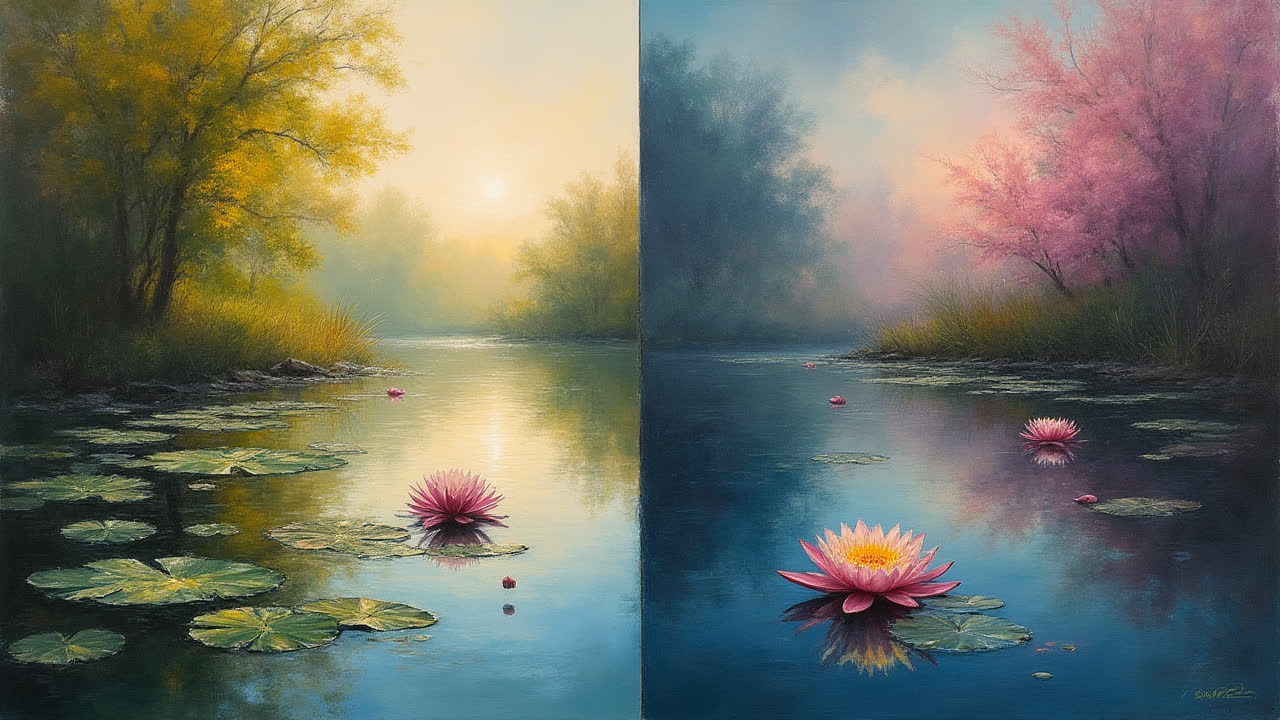
At its core, Impressionism sought to capture the impression of a moment, particularly focusing on how light affects our perception of scenes and objects. Impressionist artists were interested in scientific developments regarding optics and color theory, which influenced their approach to painting. They wanted to depict the world as it appeared to the eye in a specific moment, rather than how it objectively existed. This led to a focus on outdoor scenes, everyday life, and natural lighting conditions.
Expressionism, however, turned inward, prioritizing the artist's emotional and psychological response to the world. Expressionist artists weren't concerned with depicting objective reality but rather with expressing subjective emotions and responses that objects and events aroused within them. This introspective approach resulted in works that often distorted physical reality to convey emotional intensity. Where Impressionism sought to capture the external world as it appeared, Expressionism aimed to project the internal world of feelings onto the canvas.
I've always found it incredible how Impressionist paintings can make you feel as if you're standing in that exact moment of time—feeling the breeze, seeing the shimmer of light on water. And then Expressionist works hit you with raw emotion, sometimes uncomfortable but always powerful. These different intentions created not just different visual styles but entirely different emotional experiences for viewers. While Impressionists invited viewers to share in the beauty of a fleeting moment, Expressionists often confronted them with challenging emotional truths.
Technical Characteristics and Painting Styles
| Characteristic | Impressionism | Expressionism |
|---|---|---|
| Color Usage | Vibrant, often unblended colors with emphasis on light effects | Intense, arbitrary, and bold colors often unrelated to natural appearance |
| Brushwork | Spontaneous, broad strokes using painting knife or brush | Agitated, gestural, and distorted to convey extreme emotions |
| Subject Matter | Everyday scenes, landscapes, modern urban life | Often distorted figures, emotional situations, urban anxiety |
| Perspective | Unusual visual angles, but still based on visual reality | Disjointed spaces, deliberately distorted perspective |
| Emotional Tone | Generally positive, celebrating modern life and nature | Often dark, anxious, exploring psychological depths |
| Relation to Reality | Based on visual perception of reality | Deliberately distorting reality to express emotion |
| Composition | Often spontaneous, candid poses and scenes | Carefully constructed to maximize emotional impact |
| Influences | Scientific color theory, photography, Japanese prints | Primitive art, psychological theories, spiritual concepts |
Impressionist painters developed distinctive techniques to achieve their artistic goals. They often painted outdoors (en plein air) to capture the changing effects of light directly. Their brushwork consisted of short, broken strokes of pure, unmixed color placed side by side, allowing the viewer's eye to blend them optically rather than physically mixing pigments on the palette. This technique created a sense of vibration and movement, perfect for capturing fleeting moments of light and atmosphere.
Expressionist artists, meanwhile, developed techniques that emphasized emotional intensity over visual accuracy. They used bold, often non-naturalistic colors to convey feelings rather than appearance. Edvard Munch's "The Scream," with its swirling oranges and blues, exemplifies this approach. Brushstrokes were typically more aggressive and deliberate than in Impressionism, often appearing distorted or exaggerated to heighten emotional impact. The technique served the purpose of expressing inner turmoil, anxiety, and other intense emotions that characterized the modernizing world.
These technical differences weren't just stylistic choices but reflected the fundamental philosophical differences between the movements. Sometimes I wonder how much our own perception of these works is colored by our modern understanding of psychology and emotion. Would contemporary viewers of these movements have experienced them differently than we do today? The technical aspects of each movement were perfectly aligned with their intentions—Impressionism's technique created luminosity and transience, while Expressionism's approach generated emotional intensity and psychological depth.
Notable Artists and Their Works
Impressionism boasts a roster of renowned artists whose works continue to captivate audiences worldwide. Claude Monet stands as the quintessential Impressionist, with his water lilies series and the aforementioned "Impression, Sunrise" defining the movement. Other prominent figures include Camille Pissarro, known for his rural and urban landscapes; Alfred Sisley, who focused almost exclusively on landscape painting; Édouard Manet, whose work bridged Realism and Impressionism; and Armand Guillaumin, recognized for his intense use of color. These artists, along with others like Auguste Renoir and Berthe Morisot, formed the core of the Impressionist movement.
Expressionism, emerging later, featured artists with equally distinctive styles but wildly different emotional tones. Edvard Munch, though Norwegian, heavily influenced German Expressionism with works like "The Scream," which visually captures a feeling of existential anxiety. German artists Ernst Ludwig Kirchner, with his angular, primitive-influenced figures depicting urban life; Max Beckmann, known for his intense self-portraits; and August Macke, who brought a more colorful, optimistic approach to the movement, were central figures. Other significant Expressionists included Paul Klee, whose work evolved toward abstraction; Marc Chagall, with his dreamlike imagery; and Wassily Kandinsky, who eventually developed a fully abstract expressionist style.
What's especially interesting about these artists is how their individual styles remained distinct even within the broader movements. Monet's water lilies look nothing like Renoir's figures, yet both are unmistakably Impressionist. Similarly, Kirchner's street scenes differ dramatically from Kandinsky's abstract compositions, yet both express intense emotion rather than visual reality. I've always found it remarkable how these artists managed to develop such personal styles while still clearly belonging to their respective movements. Their individual genius and vision shaped not just their own work but the entire trajectory of modern art.
Cultural Impact and Legacy
Impressionism revolutionized art by breaking from academic traditions and paving the way for modern artistic exploration. Its emphasis on capturing fleeting moments and impressions rather than detailed reality influenced countless subsequent movements. Beyond painting, Impressionism extended its influence to music (Claude Debussy), literature, and even early cinema, with its focus on light, movement, and everyday life. Today, Impressionist paintings rank among the most beloved and valuable artworks worldwide, with exhibitions consistently drawing massive crowds.
Expressionism's impact was equally profound but took a different direction. Its psychological depth and emotional intensity laid groundwork for Abstract Expressionism, Neo-Expressionism, and even aspects of Surrealism. The movement strongly influenced German cinema, architecture, literature, and theater. Expressionist works often resonated with the anxiety of modern life, making them particularly relevant during periods of social and political upheaval. While sometimes challenging for viewers, Expressionist art created a vocabulary for depicting psychological states that continues to influence contemporary artists addressing mental health, social alienation, and existential concerns.
Looking at contemporary art, we can still see the DNA of both movements everywhere. The Impressionist legacy lives on in plein air painting, light-focused photography, and the continued popularity of landscape art that captures specific atmospheric conditions. Meanwhile, Expressionism's influence appears in emotionally charged figurative painting, psychological portraiture, and art therapy approaches that value emotional expression over technical precision. These movements didn't just change art; they changed how we see and process the world around us. Whenever I visit a modern art museum, I can't help but trace the lineage of almost every piece back to these revolutionary movements in some way.
Frequently Asked Questions
Which came first, Impressionism or Expressionism?
Impressionism emerged first, originating in Paris during the late 19th century (around the 1870s). Expressionism developed later, in the early 20th century (approximately 1905-1920), primarily in Germany and Austria. This chronological difference reflects how Expressionism partly developed as a reaction to Impressionism, taking art in a more emotionally intense direction than its predecessor.
How can I tell if a painting is Impressionist or Expressionist?
You can identify an Impressionist painting by its focus on light and atmosphere, relatively realistic depictions (though with visible brushstrokes), generally pleasant subjects from everyday life, and vibrant but natural-looking colors. Expressionist paintings, by contrast, feature distorted forms, exaggerated features, non-naturalistic and often intense colors, and subjects that evoke strong emotions—often anxiety, alienation, or psychological states. Impressionist works feel like captured moments, while Expressionist works feel like emotional states made visible.
Were Impressionism and Expressionism popular during their time?
Initially, Impressionism faced harsh criticism from the art establishment and traditional critics, who considered its unfinished appearance and departure from academic techniques to be scandalous. However, by the late 19th century, it had gained significant popularity and commercial success. Expressionism, emerging during more turbulent times in Europe, was often controversial and divisive throughout its development. It gained recognition among avant-garde circles but achieved broader appreciation only retrospectively, particularly after World War II when its emotional intensity and psychological insights became more widely valued.
Conclusion
Understanding the difference between Impressionism and Expressionism offers us valuable insights not just into art history, but into the changing psychological and social landscape of Europe during a pivotal period of modernization. While Impressionism captured the visual excitement and sensory experience of the modern world, Expressionism plunged into its psychological depths and emotional complexities.
Both movements represented revolutionary breaks from tradition, though in different ways and for different purposes. Impressionism liberated artists to capture the sensory experience of the modern world with new techniques and approaches, while Expressionism freed them to express subjective emotional states through distortion and exaggeration. Together, they expanded the very definition of what art could be and do.
As we reflect on these movements today, we can appreciate how they continue to influence contemporary art and culture. The Impressionist's celebration of light, moment, and perception balances beautifully with the Expressionist's exploration of emotion, psychology, and subjective experience. In many ways, they represent two essential aspects of human experience—how we perceive the world around us and how we feel about it. What's your personal response to these movements? Do you find yourself drawn more to the luminous moments of Impressionism or the emotional intensity of Expressionism? Either way, these groundbreaking artistic approaches continue to enrich our understanding of both art and the human experience.
References:
- http://www.artmovements.co.uk/impressionismhtm
- http://mymodernmet.com/what-is-impressionism-definition/
- https://en.wikipedia.org/wiki/Impressionism
- https://en.wikipedia.org/wiki/Expressionism
- http://www.artmovements.co.uk/expressionism.htm
- https://commons.wikimedia.org/w/index.php?curid=5504881
- https://commons.wikimedia.org/w/index.php?curid=5710069
- https://commons.wikimedia.org/w/index.php?curid=37624942
- https://commons.wikimedia.org/w/index.php?curid=6604307