Extends vs Implements in Java: Key Differences Explained
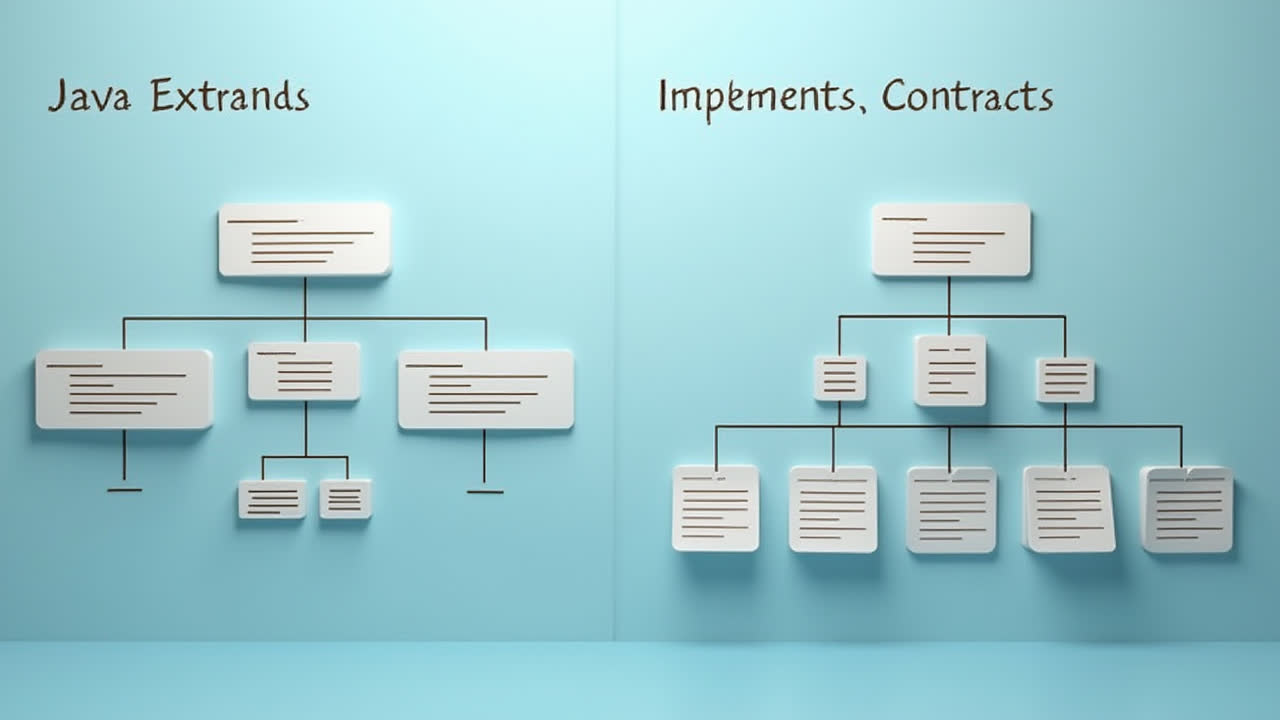
When diving into Java development, understanding the difference between extends and implements keywords is crucial for effective object-oriented programming. These two keywords represent fundamentally different concepts in Java's approach to code organization and reuse. While both help in building relationships between classes, they serve distinct purposes in the Java ecosystem.
Java stands as one of the most widely used programming languages globally, powering everything from Android applications to enterprise software systems. Created by James Gosling and released by Sun Microsystems (now owned by Oracle), Java's popularity stems largely from its robust object-oriented programming capabilities. The language's design philosophy emphasizes code reusability and modularity—principles that are directly supported by the extends and implements mechanisms.
Have you ever wondered why Java provides two different ways to establish relationships between classes? Or perhaps you're confused about when to use inheritance versus interfaces in your code? You're not alone. Even experienced developers sometimes struggle with choosing the right approach for their specific programming challenges.
In this comprehensive guide, we'll explore the fundamental differences between extends and implements, examine real-world use cases for each, and provide practical code examples to illuminate these concepts. By the end, you'll have a clear understanding of how to leverage these powerful features to write more efficient, maintainable Java code.
Understanding Extends in Java
The extends keyword in Java represents the concept of inheritance, one of the four pillars of object-oriented programming. Inheritance establishes a parent-child relationship between classes, where the child class (subclass) inherits attributes and behaviors from the parent class (superclass). This relationship is often described as an "is-a" relationship—a car is a vehicle, a dog is an animal.
When a class extends another class, it automatically gains access to all the non-private fields and methods of the parent class. This powerful mechanism promotes code reuse and allows developers to build hierarchical relationships that mirror real-world classifications. I've found that thinking about inheritance in terms of biological classification often helps new programmers grasp the concept—just as mammals inherit characteristics from vertebrates, a subclass inherits from its superclass.
Let's look at a practical example to see how extends works in Java:
// Parent class
class Vehicle {
    protected String brand = "Ford";

    public void honk() {
        System.out.println("Tuut, tuut!");
    }
}

// Child class
class Car extends Vehicle {
    private String modelName = "Mustang";

    public static void main(String[] args) {
        Car myCar = new Car();

        // Call method from Vehicle class
        myCar.honk();

        // Display the value of the brand attribute (from the Vehicle class)
        // and the value of the modelName from the Car class
        System.out.println(myCar.brand + " " + myCar.modelName);
    }
}
In this example, the Car class extends the Vehicle class, gaining access to the brand attribute and honk() method. This is a classic demonstration of inheritance in action. The Car class doesn't need to redefine these elements—it simply inherits them from Vehicle. One crucial limitation to note is that Java only supports single inheritance for classes. A class can extend only one superclass, preventing the complications that can arise from multiple inheritance.
Exploring Implements in Java
While extends deals with inheritance, the implements keyword relates to another core OOP concept: abstraction through interfaces. An interface in Java is a completely abstract class that specifies a set of methods that a class must implement. Think of an interface as a contract or a promise—any class that implements an interface guarantees to provide specific behaviors.
Interfaces allow developers to define what a class should do without specifying how it should do it. This separation between specification and implementation creates more flexible, loosely coupled systems. Unlike with extends, a class can implement multiple interfaces, which helps Java overcome the limitation of single inheritance.
Here's a simple example illustrating how implements works:
// Interface
interface Drawable {
    void draw(); // Abstract method (no implementation)
}

// Class implementing the interface
class Circle implements Drawable {
    // The class must implement the draw() method
    public void draw() {
        System.out.println("Drawing a circle");
    }

    public static void main(String[] args) {
        Circle myCircle = new Circle();
        myCircle.draw();
    }
}
In this example, the Circle class implements the Drawable interface, which requires it to provide an implementation for the draw() method. The interface only declares what the method should be named and what parameters it should accept—it's up to each implementing class to define the actual behavior.
One of the most powerful aspects of interfaces is that they enable polymorphism. Multiple classes can implement the same interface but provide different implementations of its methods. This flexibility allows developers to write code that works with objects based on what they can do rather than what they are.
Extends vs Implements: Head-to-Head Comparison
| Feature | Extends | Implements |
|---|---|---|
| OOP Concept | Inheritance | Abstraction through interfaces |
| Purpose | Reuse code and establish parent-child relationships | Define a contract that classes must fulfill |
| Relationship Type | "Is-a" relationship (e.g., Car is a Vehicle) | "Can-do" relationship (e.g., Car can be Drivable) |
| Multiple Support | Class can extend only one class (single inheritance) | Class can implement multiple interfaces |
| Method Implementation | Parent class can provide default implementations | Interface methods traditionally have no implementation (prior to Java 8) |
| Access to Member Variables | Subclass inherits fields from superclass | Interface can only declare constants (public static final) |
| Constructor Inheritance | Constructors are not inherited but can be called using super() | Interfaces don't have constructors |
| Evolution Impact | Adding methods to a superclass may break subclasses | Prior to Java 8, adding methods to interfaces broke implementing classes |
When to Use Extends
Choosing between extends and implements isn't always straightforward. It requires an understanding of your specific use case and the relationships between your classes. Let's examine scenarios where extends is the more appropriate choice:
Use extends when there's a clear "is-a" relationship between classes. For example, if you're modeling different types of vehicles, a Car "is a" Vehicle, so it makes sense for Car to extend Vehicle. Similarly, if you're creating a hierarchy of shapes, a Rectangle "is a" Shape, so Rectangle should extend Shape.
Extends is also appropriate when you want to inherit both behavior (methods) and state (fields) from a parent class. When building an application with different types of user accounts (like StandardUser and AdminUser), both would extend a base User class to inherit common attributes like username, email, and authentication methods.
Another compelling case for extends is when you need to override or extend behavior from a parent class. For instance, when working with UI frameworks, you might extend a base Component class to customize rendering or event handling. In my experience developing Android applications, extending the Activity class to create custom screens is a perfect example of appropriate inheritance use.
However, inheritance comes with potential pitfalls. The tight coupling between parent and child classes can make your code less flexible. Changes to the parent class might unexpectedly affect subclasses, and the inheritance hierarchy can become complex and difficult to maintain as your application grows. This phenomenon, often called the "fragile base class problem," should be considered before choosing inheritance.
When to Use Implements
While extends is about "is-a" relationships, implements focuses on "can-do" relationships. Use implements when you want to define a contract that classes must fulfill, regardless of their place in an inheritance hierarchy. This approach is particularly useful in defining cross-cutting behaviors that may apply to otherwise unrelated classes.
Implements shines in scenarios where multiple inheritance would be useful. Since Java doesn't support multiple inheritance with classes, interfaces provide a way to inherit behavior from multiple sources. For example, a Smartphone class might need to be both Callable and Networkable—two behaviors that don't necessarily share a common parent class.
Interfaces are also valuable for achieving loose coupling between components. When classes depend on interfaces rather than concrete implementations, it becomes easier to swap out implementations without affecting the rest of the system. This principle, known as "programming to an interface, not an implementation," is a cornerstone of flexible, maintainable code.
Modern Java (8 and later) has enhanced interfaces with default methods and static methods, blurring the line somewhat between interfaces and abstract classes. These features allow interfaces to provide implementation details while still maintaining their role as contracts. Default methods in particular have made interfaces more powerful and adaptable—they can evolve without breaking existing implementations.
Despite these advantages, implements still has limitations. Interfaces cannot include state (instance variables), making them unsuitable for cases where both behavior and state need to be shared. Additionally, implementing multiple interfaces can lead to method signature conflicts that must be resolved manually.
Real-World Usage Patterns
In professional Java development, you'll often encounter specific patterns involving extends and implements. Understanding these patterns can help you make better design decisions in your own code.
One common pattern is the "Template Method" pattern, which relies on inheritance (extends). In this pattern, a parent class defines the skeleton of an algorithm, deferring some steps to subclasses. For example, a DataProcessor class might define a process() method that calls abstract methods like readData(), transformData(), and writeData(), which subclasses must implement.
Another widespread pattern is the "Strategy" pattern, which leverages interfaces (implements). This pattern defines a family of algorithms, encapsulates each one, and makes them interchangeable. A classic example is sorting algorithms: different classes implementing a Sortable interface can provide various sorting strategies that can be swapped at runtime.
In Java's standard library, you'll find many examples of both approaches. The Collections framework uses inheritance extensively, with AbstractList, AbstractSet, and AbstractMap providing default implementations for their respective collection types. Meanwhile, interfaces like Comparable, Runnable, and Callable define contracts that classes across the library implement to provide specific behaviors.
Modern Java development often favors composition over inheritance, leading to greater use of interfaces. This trend is particularly visible in frameworks like Spring, which heavily utilize interfaces for dependency injection and aspect-oriented programming. However, inheritance remains valuable in specific contexts, such as UI frameworks and when working with legacy code.
Frequently Asked Questions
Can a class both extend a class and implement interfaces in Java?
Yes, a Java class can simultaneously extend one class and implement multiple interfaces. This is a powerful combination that allows a class to inherit state and behavior from a parent class while also fulfilling multiple contracts defined by interfaces. The syntax for this is:
class MyClass extends ParentClass implements Interface1, Interface2 {
    // Class implementation
}
This approach is common when you need both the code reuse benefits of inheritance and the flexibility of interfaces. For instance, many Java UI components extend a base component class while also implementing listener interfaces to handle various events.
What's the difference between an interface and an abstract class in Java?
While both interfaces and abstract classes provide abstraction, they differ in several key ways:
- Implementation details: Abstract classes can have concrete methods with implementations, while interfaces (prior to Java 8) could only have method declarations.
- State: Abstract classes can have instance variables (state), whereas interfaces can only have constants.
- Inheritance: A class can extend only one abstract class but implement multiple interfaces.
- Purpose: Abstract classes are designed for objects of the same type with shared characteristics, while interfaces define capabilities that unrelated classes might implement.
- Constructor: Abstract classes can have constructors, but interfaces cannot.
Since Java 8, the lines have blurred somewhat with the introduction of default methods in interfaces, but these fundamental differences remain important considerations in your design decisions.
How have interfaces evolved in modern Java versions?
Interfaces have undergone significant evolution in modern Java versions:
- Java 8: Introduced default methods (methods with implementations) and static methods in interfaces. This allowed interfaces to evolve without breaking existing implementations and provided utility methods related to the interface.
- Java 9: Added private methods to interfaces, enabling code reuse within default methods and reducing duplication.
- Java 10-17: Further refined these features with improvements to type inference and handling of private methods.
These changes have made interfaces more flexible and powerful, allowing them to provide some implementation details while maintaining their primary role as contracts. For example, the Collection interface now includes default methods like forEach() and stream() that provide common functionality to all collection implementations without requiring each implementation to define them.
Conclusion
Understanding the difference between extends and implements is crucial for writing effective, maintainable Java code. These keywords represent two fundamental approaches to code organization and reuse in object-oriented programming: inheritance and interface implementation.
To summarize the key differences: extends creates an "is-a" relationship between classes, enables code reuse through inheritance, and allows a class to inherit both state and behavior from a single parent. In contrast, implements establishes a "can-do" relationship, enforces a contract that classes must fulfill, and allows a class to adopt multiple behaviors from different sources.
The choice between extends and implements isn't always clear-cut and often depends on your specific use case. As a general guideline, prefer extends when dealing with clear hierarchical relationships and shared implementation, and favor implements when defining capabilities that might apply to unrelated classes or when you need the flexibility of multiple inheritance.
Modern Java development often combines both approaches, with classes extending a parent while implementing multiple interfaces. This hybrid approach leverages the strengths of both mechanisms while mitigating their individual limitations. As Java continues to evolve, with enhancements like default methods in interfaces, the distinction between these approaches may continue to blur, but their fundamental purposes remain distinct and valuable.
Mastering extends and implements is just one step in your journey as a Java developer, but it's a crucial one that will influence how you structure and organize your code for years to come. By applying the principles and patterns discussed in this article, you'll be well-equipped to design more flexible, maintainable, and effective Java applications.